




The competition in the global shipbuilding industry has intensified, and China is leading the development of the industry.
In recent years, the competition in the global shipbuilding industry has become increasingly fierce. However, China has emerged as a powerful force in this race and has become a key player leading the development of the industry. From the remarkable growth in market share, to the continuous breakthroughs in technological innovation, and to the strong support of industrial policies, China's shipbuilding industry is rising at a remarkable speed and reshaping the global shipbuilding landscape.
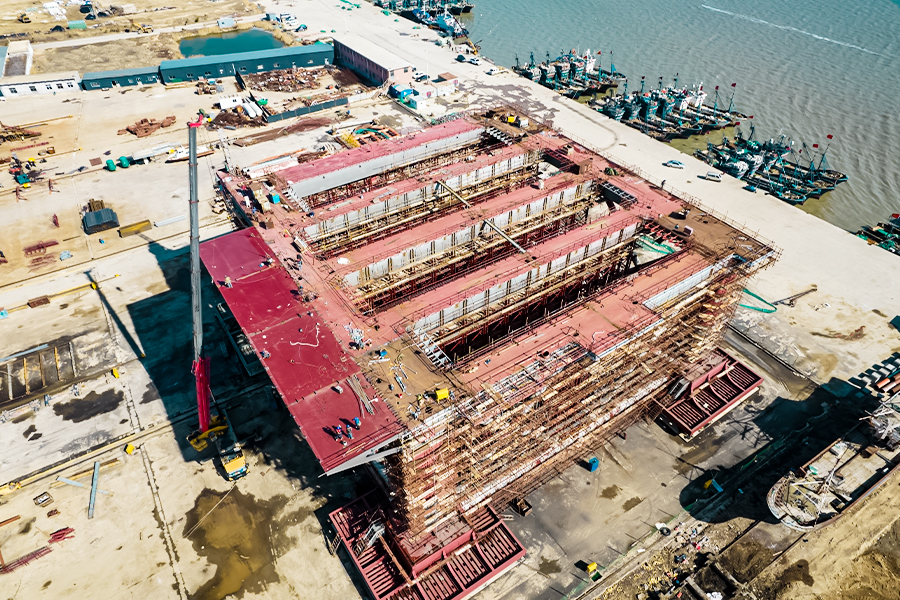
The market share has significantly jumped, and China has become the main force in global shipbuilding.
Data is the most powerful proof. Currently, China accounts for nearly 65% of the global ship orders, a number that has achieved a leapfrog growth compared to less than 10% in 2000. In 2023, in terms of deadweight tonnage, China's completed shipbuilding volume, newly received orders volume, and orders on hand respectively accounted for 50.2%, 66.6%, and 55.0% of the global total. The international market share of the three major shipbuilding indicators all exceeded 50% for the first time. Entering 2024, this advantage continues. In the first quarter, in terms of deadweight tonnage, China's completed shipbuilding volume, newly received orders volume, and orders on hand respectively accounted for 53.8%, 69.6%, and 56.7% of the global total. According to Clarkson's prediction, China's completed shipbuilding volume in 2024 will be around 45 million deadweight tons, and the newly received orders volume will be around 55 million deadweight tons.
China not only has an advantage in the total volume of orders but also has achieved remarkable results in the field of segmented ship types. In 2023, among the 18 major ship types globally, China ranked first in the newly received order volume of 14 ship types. In the field of tankers, China's competitiveness has exceeded that of South Korea since 2022. In terms of orders for green-powered ships, in 2023, the proportion of newly received orders for green-powered ships from China in the international market share exceeded 50% for the first time, reaching 57%, and achieved full coverage of mainstream ship types.
In contrast, the market shares of traditional shipbuilding powerhouses, South Korea and Japan, have declined. Taking 2023 as an example, in terms of the total book value of orders for container ships, bulk carriers, tankers, liquefied petroleum gas (LPG) carriers, and liquefied natural gas (LNG) carriers, China accounted for 46% of the global market share, while South Korea ranked second with a market share of 41%. A report by the Korea Industrial Institute showed that in 2023, China surpassed South Korea in terms of the comprehensive competitiveness of the shipbuilding industry value chain and ranked first.
Driven by Technological Innovation, China's Shipbuilding Industry Marches towards the High-end
Against the backdrop of intensifying competition in the global shipbuilding industry, technological innovation has become the key to success, and China is making great strides in this regard. On the one hand, China continues to refine its construction technologies for traditional ship types, improving production efficiency and the quality of ships. On the other hand, it is actively making arrangements in emerging fields and has achieved remarkable progress in aspects such as dual-fuel power and green energy ships.
Green ships such as the world's largest 5,400-horsepower pure electric tugboat independently developed by China and China's first 500-kilowatt hydrogen fuel cell-powered ship have been successively put into use, demonstrating China's leading position in green ship technology. At the same time, a number of new breakthroughs have been achieved in new energy marine equipment. Bloomberg has noticed that in addition to planning to build more ships powered by clean energy sources such as liquefied natural gas and methanol, China also plans to accelerate the research and development of new types of transport ships for liquid ammonia, liquid hydrogen, liquid carbon dioxide, etc.
With the official delivery of China's first domestically-made large cruise ship, "Adora Magic City", China has gathered the three "pearls on the crown" of the world's shipbuilding industry: aircraft carriers, liquefied natural gas (LNG) carriers, and large cruise ships, and its R&D and design capabilities for high-end ships are moving towards the goal of leading the world. On April 29, China State Shipbuilding Corporation signed a contract with QatarEnergy for a project of 18 of the world's largest very large liquefied natural gas (LNG) carriers with a volume of 271,000 cubic meters each. This marks that China's R&D, design, and construction of LNG carriers have leaped from the large-scale category to the very large-scale category at one go.
Supported by industrial policies, a solid foundation is established for the development of the shipbuilding industry.
The rapid development of China's shipbuilding industry is inseparable from the strong support of national industrial policies. In 2019, two major shipbuilding enterprises in China, China State Shipbuilding Corporation (CSSC) and China Shipbuilding Industry Corporation (CSIC), carried out a restructuring, creating the world's largest shipbuilding group and enhancing the global competitiveness of China's shipbuilding industry.
In 2023, China issued the "Action Outline for the Green Development of the Shipbuilding Industry (2024-2030)", proposing that by 2025, a preliminary green development system for the shipbuilding industry will be established, and the international market share of green-powered ships using liquefied natural gas (LNG), methanol, etc. will exceed 50%; by 2030, the green development system for the shipbuilding industry will be basically established. Guided by the policies, Chinese shipbuilding enterprises have increased their investment in green manufacturing and technological upgrading, promoting the sustainable development of the industry.
From the perspective of industrial clusters, China has formed several industrial agglomeration areas for ships and offshore engineering equipment, such as the Minjiang Estuary and Sandu'ao. An industrial chain that connects the upstream, midstream, and downstream sectors has been initially established. The effect of industrial clusters not only reduces production costs but also promotes technical exchanges and innovation, further enhancing the overall competitiveness of China's shipbuilding industry.
Facing the situation of intensifying competition in the global shipbuilding industry, China has successfully led the development of the industry by virtue of its advantages in various aspects such as market share, technological innovation, and industrial policies. In the future, China's shipbuilding industry will continue to deepen innovation and optimize the product structure. It will serve the global market with higher-quality and more environmentally friendly ship products, injecting new vitality into the global shipping and shipbuilding industries.